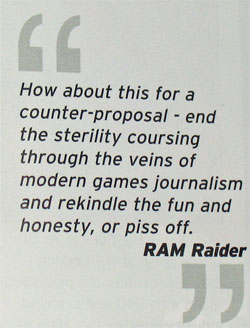
Our thoughts on how journalists are becoming indistinguishable from PR mouthpieces are no secret. MCV (p.17, 3/11/06) published our proposition to lead us not into temptation:
“Every so often, the question of whether games journalists count as being part of the games industry is raised. The question is largely based on semantics: of course games journalists (or at least the specialist press) are just as much a part of the industry as the publishers, the PR and the marketers, but they’re not directly involved in the process of making games.
But the truly important question isn’t about whether or not games journalists are part of the industry.
The question that should be asked – strongly – is: “Are journalists independent of the industry?” If they’re not, the specialist press is in trouble.
In a debate about the first question on Sony’s David Jaffe “cake’s” blog some time ago, I reminded every reader of the true purpose of the games media. The free press is there to commentate, to critique, and to inform the public.
Or, in less flowery terms, to test out games and tell you if they’re worth buying.
To carry out this role competently and fairly, journalists have to be impartial and professionally unbiased. Despite this, publishers pour collective millions into the pockets of PR machines whose jobs are to make sure the journalists are talking about their games.
The PR folk achieve this by lavishing journalists with treats, from previews of games through to expensive trips abroad – complete with a quick look at the code, shoehorned between dinner and a lapdance.
Most press events are overblown and unnecessary. Because of the needless luxuriance of these jollies, which often see journalists being flown to fancy locations around the world, hacks become open to suggestion. Maybe these journalists who are supposed to be taking an unbiased and impartial view of a game aren’t quite living up to their readers’ expectations.
It would be unsportsmanly to suggest journalists are deliberately nice about a game because of the attention they’ve received courtesy of that nice PR man’s credit card. But it’s nothing more than natural to assume that maybe, just maybe, the critics might be slightly influenced, even if sub-consciously, when summing up the latest release.
There you are ready to start ripping the game apart before you suddenly remember how nice Mr. PR Man always is to you, and, oh, the fun we all had on that trip, and those developers are just so dang ‘nice’… where was I? Oh yes, maybe I won’t mention that below-par bit of the game after all…
And that’s where the danger lies. A critic is supposed to approach a game just as a reader of their magazine or website would. The problem is the critic has played several versions of the preview code, interviewed the developers, and been arse-kissed by the PR. In some cases, they’ve actually had their faces scanned into the game or have got to record their voice as one of the characters. They’re as far removed from an everyday purchaser you can get.
One of my Anonymous Knights recently commented that reviewers should be made to list all the free stuff they’ve been given, as well as any contact they’ve had with the game’s makers.
I’d propose something stronger: don’t assign the review of a game to the journalist who’s been to press events and seen previous versions of the code unavailable to the public.
Give it to someone who can approach it with a fresh and unbiased perspective, just like those who eventually purchase the game at retail.
Reviewers are only human, so lead them not into temptation. Otherwise, they’re more a part of the industry than they ever should be.”
The original comment we posted on David Jaffe’s blog a year ago was this:
“I think two issues have been confused here. The first is the notion that games journalists/writers/critics/whatever aren’t part of “the industry”. Just like movie critics are an integral and vital element of the movie industry and music critics are likewise for the music industry, games critics are just a much a part of the games industry. An industry is made of elements that if one was removed, the whole would fail. The movie, music and games industries would be nothing without their respective press, as there would be no interface between the consumer and the creators. The second issue is that games “journalists” simply don’t live up to their job descriptions. The point made about magazines being full of PR puff is valid as, speaking as a UK journalist, most magazines are glorified mouthpieces that pander to PR whims. “Features” start and end with press trips laid on by PR firms or publishers, and result in little more than speculation wrapped up in positive spin. Good, honest, aggressive (but fair) journalism is all but impossible to achieve now, but it’s not always the fault of the journalists. While some are content to sit back rewriting press releases, the specialist UK games press is monopolised by a publishing house which, in association with the selective PR firms, calls all the shots when it comes to what gets covered by its magazines and journalists. This effectively makes the concept of independent editorial thinking and a truly free press a fiction. The only journalists brave enough to stand up and speak their minds are quickly shunned and blacklisted from the “club”, leaving true honesty to be the bastion of the exiled, or working journalists cowering behind a shield of anonymity.”
And here’s a shit quality scan of the MCV article:
“Every so often, the question of whether games journalists count as being part of the games industry is raised. The question is largely based on semantics: of course games journalists (or at least the specialist press) are just as much a part of the industry as the publishers, the PR and the marketers, but they’re not directly involved in the process of making games.
But the truly important question isn’t about whether or not games journalists are part of the industry.
The question that should be asked – strongly – is: “Are journalists independent of the industry?” If they’re not, the specialist press is in trouble.
In a debate about the first question on Sony’s David Jaffe “cake’s” blog some time ago, I reminded every reader of the true purpose of the games media. The free press is there to commentate, to critique, and to inform the public.
Or, in less flowery terms, to test out games and tell you if they’re worth buying.
To carry out this role competently and fairly, journalists have to be impartial and professionally unbiased. Despite this, publishers pour collective millions into the pockets of PR machines whose jobs are to make sure the journalists are talking about their games.
The PR folk achieve this by lavishing journalists with treats, from previews of games through to expensive trips abroad – complete with a quick look at the code, shoehorned between dinner and a lapdance.
Most press events are overblown and unnecessary. Because of the needless luxuriance of these jollies, which often see journalists being flown to fancy locations around the world, hacks become open to suggestion. Maybe these journalists who are supposed to be taking an unbiased and impartial view of a game aren’t quite living up to their readers’ expectations.
It would be unsportsmanly to suggest journalists are deliberately nice about a game because of the attention they’ve received courtesy of that nice PR man’s credit card. But it’s nothing more than natural to assume that maybe, just maybe, the critics might be slightly influenced, even if sub-consciously, when summing up the latest release.
There you are ready to start ripping the game apart before you suddenly remember how nice Mr. PR Man always is to you, and, oh, the fun we all had on that trip, and those developers are just so dang ‘nice’… where was I? Oh yes, maybe I won’t mention that below-par bit of the game after all…
And that’s where the danger lies. A critic is supposed to approach a game just as a reader of their magazine or website would. The problem is the critic has played several versions of the preview code, interviewed the developers, and been arse-kissed by the PR. In some cases, they’ve actually had their faces scanned into the game or have got to record their voice as one of the characters. They’re as far removed from an everyday purchaser you can get.
One of my Anonymous Knights recently commented that reviewers should be made to list all the free stuff they’ve been given, as well as any contact they’ve had with the game’s makers.
I’d propose something stronger: don’t assign the review of a game to the journalist who’s been to press events and seen previous versions of the code unavailable to the public.
Give it to someone who can approach it with a fresh and unbiased perspective, just like those who eventually purchase the game at retail.
Reviewers are only human, so lead them not into temptation. Otherwise, they’re more a part of the industry than they ever should be.”
The original comment we posted on David Jaffe’s blog a year ago was this:
“I think two issues have been confused here. The first is the notion that games journalists/writers/critics/whatever aren’t part of “the industry”. Just like movie critics are an integral and vital element of the movie industry and music critics are likewise for the music industry, games critics are just a much a part of the games industry. An industry is made of elements that if one was removed, the whole would fail. The movie, music and games industries would be nothing without their respective press, as there would be no interface between the consumer and the creators. The second issue is that games “journalists” simply don’t live up to their job descriptions. The point made about magazines being full of PR puff is valid as, speaking as a UK journalist, most magazines are glorified mouthpieces that pander to PR whims. “Features” start and end with press trips laid on by PR firms or publishers, and result in little more than speculation wrapped up in positive spin. Good, honest, aggressive (but fair) journalism is all but impossible to achieve now, but it’s not always the fault of the journalists. While some are content to sit back rewriting press releases, the specialist UK games press is monopolised by a publishing house which, in association with the selective PR firms, calls all the shots when it comes to what gets covered by its magazines and journalists. This effectively makes the concept of independent editorial thinking and a truly free press a fiction. The only journalists brave enough to stand up and speak their minds are quickly shunned and blacklisted from the “club”, leaving true honesty to be the bastion of the exiled, or working journalists cowering behind a shield of anonymity.”
And here’s a shit quality scan of the MCV article: